Scleral Lenses for Keratoconus: Who Needs Them and How They Improve Vision
Living with progressive vision changes can feel incredibly isolating, especially when standard eyeglasses or soft contact lenses no longer deliver crisp, clear images. For patients diagnosed with keratoconus, the clear front dome of the eye, the cornea, slowly thins out and bulges forward into an irregular, asymmetrical cone shape. This structural distortion bends incoming light in chaotic directions, resulting in ghost images, severe glare, and persistent blurriness that standard visual aids cannot correct.
When the corneal surface becomes highly irregular, the limits of traditional eyeglasses are reached, prompting patients to seek a specialized option to restore their quality of life and visual independence.
Navigating advanced options for irregular corneas requires guidance from a highly qualified clinical professional with expertise in complex eye tracking and structural biology. If you are struggling with failing vision and require a precise, high-definition optical solution, consulting an expert is your most important next step.
Partnering with a premier Keratoconus Specialist in Mumbai opens the door to cutting-edge diagnostic mapping and advanced custom lens fittings that can comfortably transform your daily visual experience. Finding the right custom lens approach can help you see the world clearly once again.
What Are Scleral Lenses?

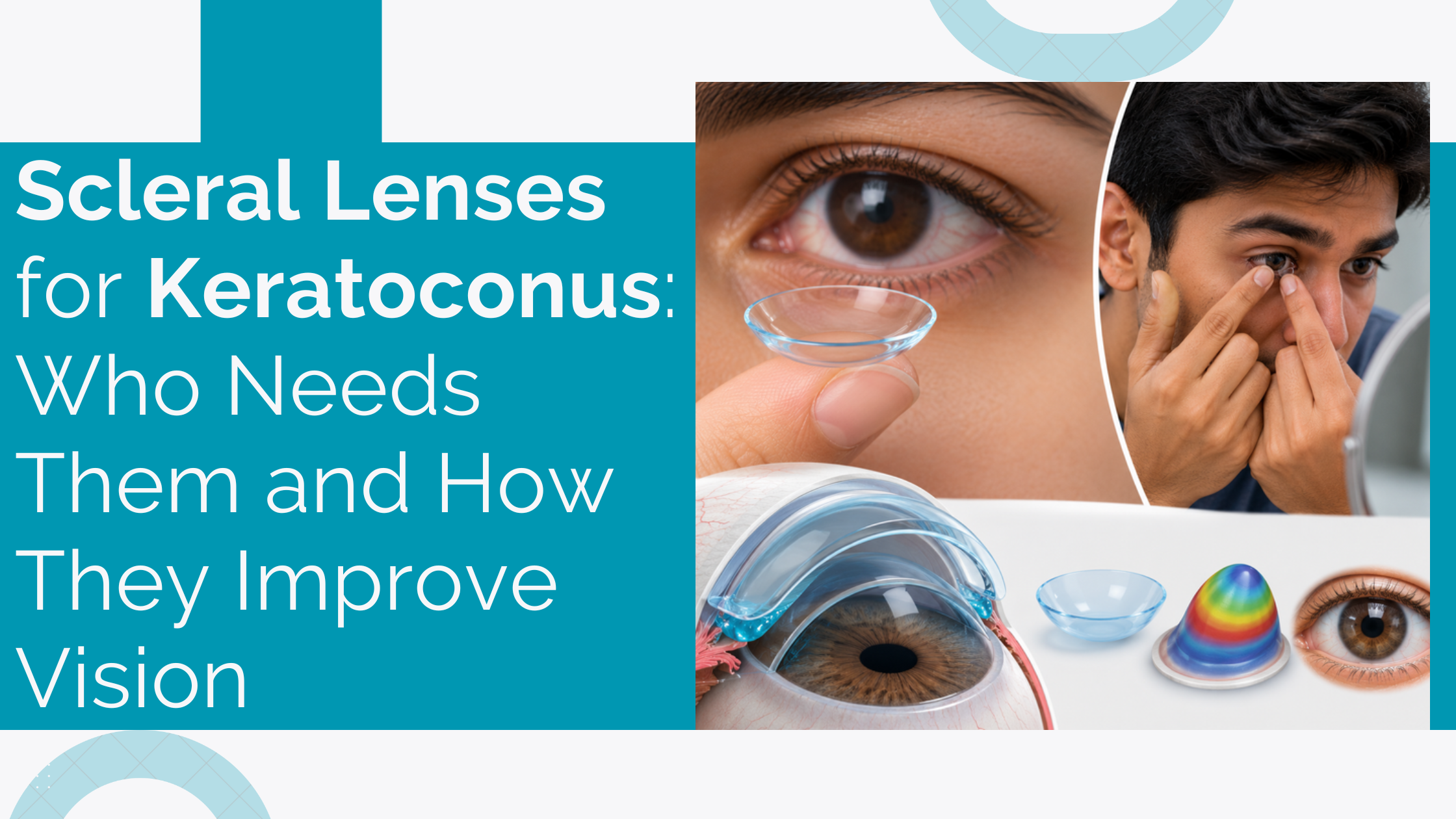
Unlike standard soft contact lenses that rest directly on the ultra-sensitive corneal surface, scleral lenses are large-diameter, rigid gas-permeable (RGP) lenses. They are specially engineered to vault completely over the irregular, thinned cornea without touching it at all. Instead, these advanced lenses rest gently on the white part of the eye, which is called the sclera.
By arching over the uneven cone-like structures, a scleral lens creates a completely smooth, stable fluid layer between the back of the lens and the front of your eye. This fluid reservoir serves a dual purpose: it continuously hydrates the eye. It acts as a brand-new, optically perfect front surface that straightens out incoming light rays before they reach your retina.
Key Structural Differences in Specialized Eyewear
Understanding why scleral designs succeed where traditional contact lenses fail comes down to basic ocular geometry and material science.
Feature Type | Standard Soft Contact Lenses | Scleral Contact Lenses |
Resting Position | Sits directly on the sensitive cornea. | Vaults over the cornea, resting on the sclera. |
Surface Shape | Conforms completely to the irregular cone. | Provides a perfectly smooth, rigid optical surface. |
Moisture Control | Can dry out and absorb tear film. | Holds a continuous reservoir of soothing saline. |
Stability Level | Shifts easily with every blink. | Stays firmly centered, minimizing friction. |
Who Needs Scleral Lenses?

While these advanced devices are undoubtedly beneficial, they are generally recommended for specific clinical situations where simpler alternatives are not sufficient. A thorough evaluation will determine if your corneal shape makes you an ideal candidate.
- Advanced Corneal Bulging: Patients whose keratoconus has progressed to a stage where standard glasses cause distorted “ghosting” effects.
- Intolerance to Small Hard Lenses: Individuals who tried traditional corneal RGP lenses but found them too uncomfortable, painful, or prone to popping out of the eye.
- Severe Secondary Dry Eye: People with severe ocular surface dryness and corneal thinning benefit immensely from a continuous liquid bath.
- Post-Surgical Irregularities: Patients who have undergone procedures such as corneal cross-linking or corneal transplants still require optimal vision correction.
Clinical Expertise for Complex Corneal Trajectories

Fitting a scleral lens is a highly technical art form that demands a deep background in corneal topography and refractive surgery management. Dr. Vinay Agrawal is widely recognized as one of the most commended ophthalmologists practicing today, bringing over 30 years of elite clinical dedication to his patients.
He earned his foundational credentials through an M.B.B.S., an M.S. in Ophthalmology, and a D.N.B. in Ophthalmology, which he then followed with a highly prestigious Cornea Fellowship at the world-renowned L.V. Prasad Eye Institute. Throughout his three decades of active ophthalmic practice, he has accumulated deep, specialized experience in advanced cataract removal, tracking of complex corneal disease, and intricate refractive surgeries.
Today, his decades of practice focus heavily on these specialty fields, allowing him to deliver highly accurate, custom visual rehabilitation outcomes at Clear Vision Eye Centre.
How Scleral Devices Revolutionize Visual Clarity

The visual improvements provided by a well-fitted scleral lens are often immediate and life-changing for patients dealing with corneal distortion. By replacing the uneven corneal surface with a pristine optical shield, these lenses address the root causes of irregular visual errors.
Patient Symptom | How the Scleral System Fixes It | Visual Outcome |
Multiple Ghost Images | Eliminates irregular light scattering across the cone. | Crisp, single-image focused vision. |
Severe Halos and Glare | Uses premium rigid materials to unify light entry. | Safer, more comfortable night driving. |
Gritty, Painful Rubbing | Keeps a constant cushion of fluid over the eye. | Long-lasting comfort throughout the day. |
What to Expect During a Custom Fitting Process
Getting fitted for these advanced tools is a detailed, multi-step process that ensures your lenses are perfectly customized to the unique micro-contours of your eyes.
1. High-Resolution Corneal Topography: The clinical team captures a 3D digital map of your eye’s surface to analyze the exact height and steepness of the cone.
2. Diagnostic Vault Evaluation: The specialist places a trial lens on your eye and uses a specialized blue-light microscope to evaluate the clearance gap between the lens and the cornea.
3. Custom Sub-Micron Ordering: Precise specifications are sent to a high-tech laboratory, where specialized software cuts your custom lens from gas-permeable polymers.
4. Handling and Training Sessions: You will learn easy, practical techniques for filling the lens with sterile saline solution, inserting it comfortably, and removing it safely at the end of each day.
Exploring Advanced Vision Solutions
If you or a loved one is experiencing progressive blurriness, it is essential to recognize that simple lifestyle shifts alone are not enough to correct an irregular corneal shape. Securing top-tier Keratoconus Treatment in Mumbai gives you immediate access to highly accurate diagnostic scanners and state-of-the-art contact lens designs. Modern science ensures that you do not have to accept poor vision as an unchangeable reality.
Looking at broader options for comprehensive Keratoconus Treatment in India allows patients to access global-standard medical paths that effectively stabilize the eye walls and sharpen visual acuity. Taking a proactive approach to your ocular health can protect your eyes from progressive decline and ensure a much brighter, clearer tomorrow.
To begin your personal journey toward sharper sight and customized, high-definition comfort, contact the dedicated corneal care team at Clear Vision Eye Centre to book an appointment with Dr. Vinay Agrawal, your trusted Keratoconus Specialist in Mumbai.
Regain Your Visual Clarity Today
Do not let progressive corneal distortion keep you from enjoying your favorite activities, reading comfortably, or driving safely at night. If standard eyeglasses are no longer working for you, advanced scleral lenses could completely transform your daily life.
Schedule your complete, high-resolution corneal mapping evaluation at Clear Vision Eye Centre with Dr. Vinay Agrawal to find out if custom scleral lenses are the right step for your eyes. Book Your Expert Consultation Now.
Frequently Asked Questions (FAQs)
How many hours a day can I comfortably wear my custom scleral lenses?
Most patients can wear their scleral lenses comfortably for 12 to 14 hours a day. Because the lens vaults over the cornea and maintains a soothing layer of preservative-free saline against the eye, it helps prevent the dryness and irritation commonly caused by traditional contact lenses.
Are scleral lenses tough to insert and remove at home?
They do require a short learning curve since they are larger than standard soft lenses. However, with the right guidance, specialized insertion plungers, and a bit of practice during your clinical training session, the process quickly becomes a simple part of your morning and evening routine.
Can scleral lenses prevent my keratoconus from worsening over time?
No, scleral lenses are designed to correct and improve your vision, not to change or stop the progression of the disease. To permanently halt the thinning and bulging of the cornea, your doctor may recommend combining your lens fitting with a stabilizing procedure such as Corneal Cross-Linking (CXL).