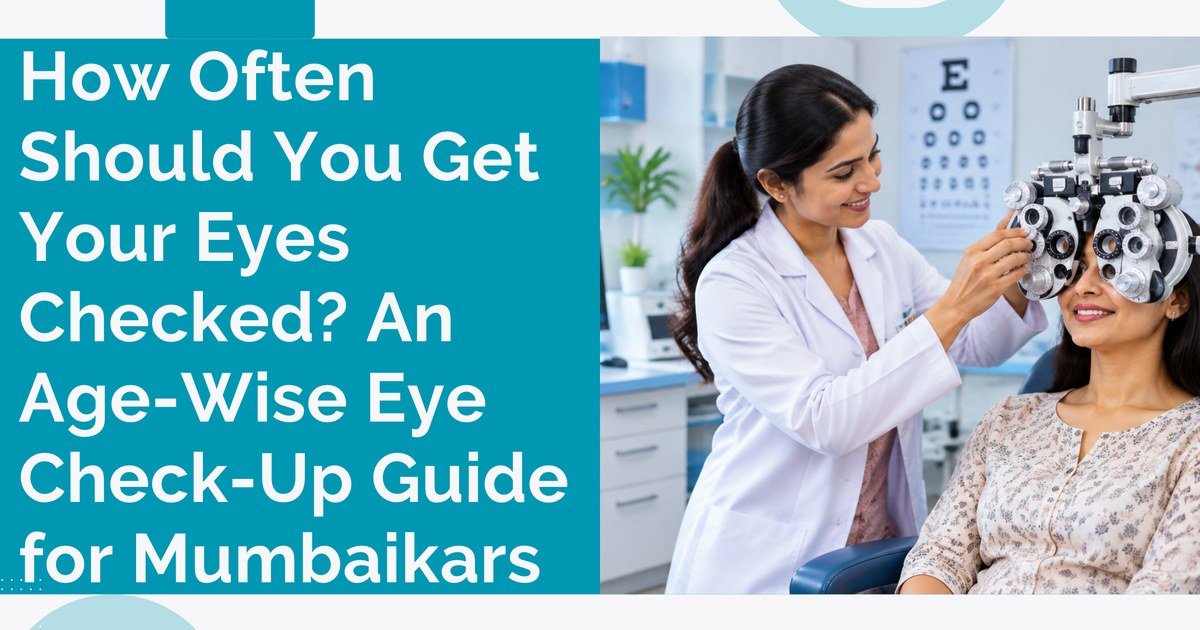
How Often Should You Get Your Eyes Checked? An Age-Wise Eye Check-Up Guide for Mumbaikars
In Mumbai the typical day begins with an early journey by train, is then spent for hours in front of a screen in a cold office, and finishes with a long trip through traffic and dust. It is the eyes that have to cope with all this. Yet, most of us don’t have an eye examination until we experience a problem such as a persistent headache, blurred vision, or a child squinting at the board in school.
The issue is that some serious eye problems show no early signs. For example, glaucoma can slowly harm your side vision for years without you noticing. So instead of asking if you need an eye test, it’s better to ask how often you should get your eyes checked. This guide explains that for each age group.
Why Waiting for Symptoms Is Risky
Many people feel that if they can see fine, their eyes must be fine. Unfortunately, that isn’t always true.
- Glaucoma often has no pain and no early symptoms. Vision is lost slowly, and once lost, it can’t be brought back.
- Cataracts build up so gradually that you may blame your glasses or the lighting.
- Refractive errors (short sight, long sight, astigmatism) can go unnoticed in children, who assume everyone sees the way they do.
- Keratoconus, where the cornea thins and bulges, often starts in the teenage years and can be missed without proper testing.
A regular comprehensive eye exam catches these early, when treatment is simpler, and results are better. It costs you an hour of your time. Late treatment can cost you far more.
How Often to Get an Eye Checkup: Age by Age

These are general guidelines for people with healthy eyes. Your ophthalmologist may suggest a different schedule if you have a medical condition or a family history of eye disease.
| Age group | Suggested eye check up frequency |
|---|---|
| Newborns to 5 years | Newborn screening, then around 6 months to 1 year, at age 3, and before school |
| 6 to 17 years | Every year if the child wears glasses; every 1 to 2 years otherwise |
| 18 to 39 years | Every 2 years, or yearly if you wear glasses or contact lenses |
| 40 to 54 years | Every 1 to 2 years, with a baseline check at 40 |
| 55 to 64 years | Every 1 to 2 years |
| 65 years and above | Every year |
Children (0 to 17): Don't Wait for the School Notice

A child’s eye checkup matters because a child’s vision is still developing. A “lazy eye” (amblyopia) that isn’t treated in early childhood can be much harder to correct later. Take your child for a vision screening before they start school, even if they seem fine.
Watch for these signs: sitting too close to the TV, frequent eye rubbing, tilting the head, complaining of headaches, or marks dropping suddenly. If your child is glued to a phone or tablet, an annual check is wise. Heavy screen time is linked with a rise in short-sightedness in children.
A word of caution on eye rubbing in teenagers. Constant rubbing, especially with itchy allergic eyes, is linked to keratoconus. If your teenager’s glasses power keeps changing, ask the doctor to check the cornea.
Young Adults (18 to 39)
This is the age when people skip check-ups because “my eyes are fine.” But long hours on laptops and phones can cause digital eye strain and dry eyes, with burning, heaviness, or blurred vision by evening. Contact lens wearers should be checked yearly, since poor lens hygiene is a common cause of infections.
Adults 40 and Above
Your near vision starts to weaken around 40, which is called presbyopia. That’s the time you begin holding your phone at arm’s length. But 40 is also when risk rises for glaucoma screening and early cataract changes. Think of a baseline exam at 40 as a starting record that your doctor can compare against in future years.
Seniors (65+)
At this age, an annual senior eye check-up is important. Cataracts, glaucoma, macular degeneration and dry eyes all become more common. If you’re finding it harder to read, drive at night, or recognize faces, it’s worth getting checked sooner than your next scheduled date.
Why Mumbai Eyes Need Extra Attention

Living in this city adds some particular pressures on your eyes:
- Pollution and dust: Constant exposure can irritate the eyes and worsen dry eye and allergies.
- Air-conditioned offices: AC dries out the eye surface, especially when you’re staring at a screen and blinking less.
- Long commutes and long screen hours: Reading on your phone in a moving train strains focusing muscles.
- Humid monsoons: Eye infections like conjunctivitis spread quickly during the rains.
If you notice persistent redness, burning, watering or grittiness, it’s better to have a doctor look rather than keep using over-the-counter eye drops.
Who Needs More Frequent Check-Ups
Some people should not wait for the standard schedule:
- People with diabetes: A dilated eye exam at least once a year, even if your vision seems normal.
- Family history of glaucoma: Start screening earlier, often from the late 30s, and ask your doctor how often to return.
- High short-sightedness (high myopia): Higher risk of retinal and glaucoma problems.
- Family history of keratoconus or a habit of eye rubbing.
- Past LASIK or other eye surgery: Yearly review.
- Long-term steroid use (tablets, inhalers or eye drops).
What Happens During an Eye Check-Up?

Many people avoid the exam because they imagine it will be painful or complicated. It isn’t. A typical comprehensive eye exam takes about 30 to 60 minutes and includes:
- History: Your symptoms, medicines, family history and daily screen use.
- Vision test: Reading letters on a chart, with and without glasses.
- Refraction: Finding your exact glasses number.
- Eye pressure test: A quick, painless check (the “air puff” or a gentle probe) that is key to glaucoma screening.
- Slit-lamp exam: A microscope look at the cornea, lens and front of the eye.
- Dilated eye exam: Drops widen your pupils so the doctor can examine the retina and optic nerve.
After dilation, your vision may be blurry and light-sensitive for a few hours. Bring sunglasses and avoid driving yourself home if possible.
Signs You Shouldn't Wait for Your Next Check-Up
See an eye doctor soon if you notice:
- Sudden blurred vision, flashes of light, or new floaters
- Eye pain or a very red eye
- Double vision
- Halos around lights, especially at night
- Frequent headaches with reading or screen work
- Loss of side vision
- A sudden change in glasses power
Choosing an Eye Specialist in Mumbai
When searching for an eye specialist in Mumbai or an eye doctor near me, look for an ophthalmologist who explains things clearly, uses modern diagnostic equipment, and gives you time to ask questions. If you’re in the western suburbs, an eye specialist in Santacruz keeps follow-ups convenient, and being close to home means you’re more likely to go back for review.
At Clear Vision Eye Centre, Dr. Vinay Agrawal and the team offer complete eye evaluations for children, adults and seniors, with specialized care for cornea, cataract, glaucoma and LASIK.
Book Your Eye Check Up Today
Your eyes do a lot for you every day. A regular check-up is one of the simplest ways to protect them. If it’s been more than a year or two since your last one, or if you’ve noticed any changes, book an eye check-up at Clear Vision Eye Centre in Santacruz, Mumbai.
Frequently Asked Questions (FAQs)
1. How often should I get my eyes checked if I have no problems?
Most healthy adults under 40 can go every 2 years, and every 1 to 2 years after 40. Children and people with risk factors may need yearly visits.
2. At what age should I start going for eye check-ups?
From infancy. Babies should be screened early, then children before school, and adults should have a baseline exam at 40.
3. Is an eye checkup painful?
No. Most tests are painless. Dilating drops may sting briefly, and your vision may be blurry for a few hours afterwards.
4. How long does an eye exam take?
A full exam usually takes 30 to 60 minutes. It may take longer if dilation drops are needed.
5. What is the cost of an eye checkup in Mumbai?
It varies depending on the tests needed, such as eye pressure measurement, dilation or corneal imaging. It’s best to call the clinic and ask what’s included.
6. Do I need an eye check-up if I'm young and wear no glasses?
Yes, a baseline exam is still useful, particularly if you spend long hours on screens or have a family history of eye disease.
7. Can eye check-ups detect glaucoma?
Yes. An eye pressure test, optic nerve examination and visual field test help detect glaucoma early, often before you notice any symptoms.
8. Should diabetics get an eye checkup every year?
Yes. Diabetes can damage the retina silently, so an annual dilated exam is strongly recommended.