Keratoconus and Eye Rubbing: Why This Habit Makes the Condition Worse
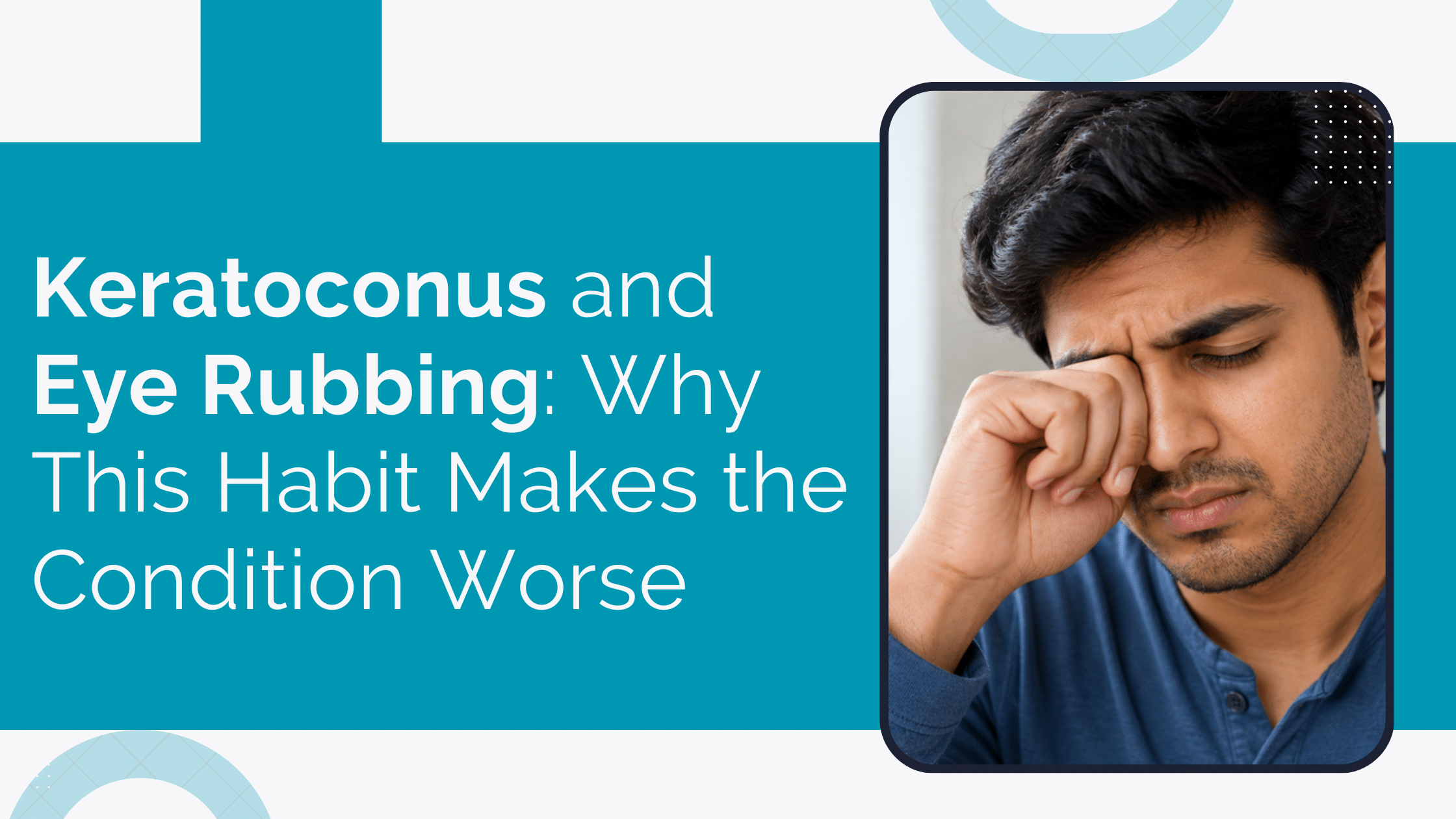
Have you ever rubbed your eyes after an exhausting day staring at a screen, or when seasonal allergies make them itch like crazy? It feels like an instant relief. For most people, it is a harmless reflex. But if your corneas are structurally weak, this everyday habit turns into a dangerous behavior.
There is a serious progressive eye condition called keratoconus, where the clear window on the front of your eye, known as the cornea, loses its stable dome shape. Instead of staying perfectly round, it thins out and begins to bulge forward into an irregular cone shape. This shifts how light enters your eye, causing blurry vision, extreme light sensitivity, and ghosted images that make normal daily life incredibly challenging to navigate.
When you struggle with chronic irritation or progressive vision loss, finding specialized clinical help is your most critical step. For anyone looking to halt this disease before it causes permanent, life-altering damage, getting a timely and accurate diagnosis makes all the difference.
Investing in comprehensive Keratoconus Treatment in Mumbai allows patients to access advanced diagnostic technologies and custom stabilization therapies that protect the eyes from failing completely. Discovering the root cause of what accelerates this issue is key to preserving your sight.
The Science Behind Eye Rubbing and Corneal Physics
To understand why rubbing your eyes is incredibly destructive, we have to look closely at the mechanical structure of the cornea. Your cornea is built from tightly woven layers of collagen fibers. These microscopic fibers act like tiny steel support beams that hold up a building, keeping the surface smooth, round, and perfectly pressurized.
When your hands put direct physical pressure on the eyelids, it alters the delicate mechanics of the eye. This external friction triggers a chain reaction that directly damages your ocular health.
- Mechanical Shearing: The physical back-and-forth friction stretches, warps, and thins out the weakened collagen layers.
- Enzymatic Degradation: Pressing on the eye releases inflammatory molecules called cytokines. These enzymes break down the collagen matrix from within, causing the tissue to lose its natural rigidity.
- Elevated Intraocular Pressure: The sudden spikes in pressure caused by your knuckles push the already thinning tissue outward, worsening the cone-like bulge.
How Friction Alters Your Corneal Shape
Regular eye rubbing does not just cause temporary redness; it permanently alters the structure of an irregular eye. Patients who suffer from chronic allergies or dry eyes often rub their eyelids multiple times a day without realizing the progressive damage they are inflicting.
Mechanical Action | Biological Consequence | Long-Term Vision Impact |
Vigorous Friction | Breaks down superficial collagen bonds. | Speeds up the thinning of the central cornea. |
Knuckle Pressure | Forces the cornea to bend past its elastic limit. | Increases irregular astigmatism and distortion. |
Epithelial Trauma | Scratches the microscopic outer protective cells. | Causes permanent corneal scarring and haze. |
The Endless Cycle of Allergic Micro-Trauma
A massive percentage of people who develop keratoconus also suffer from chronic allergic conjunctivitis or systemic allergies like hay fever. When allergens enter the eye, they trigger the release of histamines, causing an intense, unbearable itch. Rubbing gives you a brief few seconds of relief, but the physical friction causes nearby mast cells to rupture, releasing even more histamines into the surrounding tissues. This forces you into a vicious, unending loop: your eyes itch, you rub them, you release more chemicals, they itch worse, and your cornea grows thinner and more unstable by the day. Breaking this behavioral habit is just as important as any medical procedure.
Expert Care with a Trusted Corneal Surgeon
When managing a complex, progressive condition that threatens your vision, you should never rely on general care. You need a dedicated expert who understands corneal biomechanics inside and out. Bringing three decades of elite medical experience, Dr. Vinay Agrawal stands out as one of the most highly commended ophthalmic surgeons practicing today.
Having earned his M.B.B.S., M.S. in Ophthalmology, and D.N.B. in Ophthalmology, he went on to complete a highly competitive Cornea Fellowship at the prestigious L.V. Prasad Eye Institute. Over his decades of clinical work, he has developed deep expertise in advanced cataract extraction, corneal disorders, and refractive vision correction.
As a leading Keratoconus Specialist in Mumbai, he provides customized, patient-focused interventions at Clear Vision Eye Centre to preserve long-term visual health.
Modern Medical Approaches to Halting Progression
Thankfully, eye care has evolved tremendously over the last few years. If you catch the disease early enough, modern medicine can stop it right in its tracks before it steals your ability to drive, read, or see clearly.
- Corneal Cross-Linking (CXL)

This is a gold-standard, minimally invasive procedure. Doctors apply specialized riboflavin (Vitamin B2) eye drops and activate them with low-level ultraviolet light. This cross-links the collagen fibers, making the cornea stiffer and stopping the bulge from expanding.
- Scleral Contact Lenses

These are large, rigid gas-permeable lenses that vault completely over the unconventional cornea, resting gently on the whitish eye part (the sclera). They create a perfectly smooth, fluid-filled surface that bypasses the cone completely, restoring crystal-clear vision.
- Intacs Corneal Implements

These are microscopic, clear plastic semi-circular rings inserted into the middle layers of the cornea to flatten the steep cone shape, making it much easier to fit standard visual aids.
Stage of Condition | Recommended Primary Goal | Standard Treatment Path |
Early Progression | Freeze the structural deformation. | Corneal Cross-Linking (CXL) |
Moderate Structural Change | Correct severe refractive errors. | Scleral Lenses / Intacs Inserts |
Advanced Scarring | Replace non-functional, opaque tissue. | Deep Anterior Lamellar Keratoplasty (DALK) |
Practical Techniques to Eliminate the Rubbing Habit
If you have a deeply ingrained habit of rubbing your eyes, telling yourself to “just stop” rarely works. You need an active, practical game plan to protect your delicate corneal tissue from further damage:
1. Keep Preservative-Free Artificial Tears Nearby: Whenever you feel a gritty, dry sensation, flush your eyes with soothing drops instead of using your hands.
2. Apply Cold Compresses Immediately: When an intense allergic itch hits, hold a clean cloth soaked in ice-cold water over your closed eyelids for a few minutes to dull the nerve pathways.
3. Seek Prescription Antihistamines: Talk to a specialist about targeted mast-cell stabilizers that stop the allergic itch before it even starts.
4. Adopt a Strict Hands-Off Rule: If your eyes feel irritated, use the back of your clean arm to gently soothe the bone around your eye socket, completely avoiding the eyelid itself.
Take Control of Your Ocular Health
Your vision is one of your most irreplaceable assets, and understanding how your daily habits affect your eye structure is the first step toward long-term protection. If you or a family member notice rapid changes in your eyeglass prescription, frequent headaches, or a constant urge to scratch and rub your eyes, it is vital to act immediately.
Exploring options for advanced Keratoconus Treatment in India ensures you gain immediate access to world-class diagnostic tools, custom-fit specialty lenses, and collagen-stabilizing therapies. By addressing the root causes of progression and working hand-in-hand with an experienced medical team, you can actively safeguard your sight and look forward to a bright, beautifully clear future.
For comprehensive diagnostics and personalized treatment pathways designed to protect your eyes from progressive thinning, reach out to the specialists at Clear Vision Eye Centre with Dr. Vinay Agrawal today to secure your specialized Keratoconus Treatment in Mumbai.
Don't Let Eye Rubbing Steal Your Vision
Progressive corneal damage can happen silently before you notice major vision drops. If you are experiencing fluctuating vision, high astigmatism, or uncontrollable eye itching, take immediate action to protect your eyes.
Book a specialized diagnostic consultation at Clear Vision Eye Centre with Dr. Vinay Agrawal to get an accurate corneal topography map and map out your custom path for Keratoconus Treatment in Mumbai. Schedule Your Expert Appointment Today.
Frequently Asked Questions (FAQs)
Why do standard eyeglasses fail to correct vision as keratoconus advances?
Standard glasses correct regular vision issues like simple nearsightedness or basic astigmatism. As keratoconus progresses, it creates a highly irregular, asymmetrical cone shape with multiple curves. Glasses cannot bend light correctly across such an uneven surface, which is why specialized rigid or scleral lenses are required to mask the distortion.
Is corneal cross-linking (CXL) a permanent cure for corneal thinning?
Corneal Cross-Linking is designed to stop the disease from progressing by chemically strengthening the corneal tissue. While it is highly successful at permanently halting further thinning and bulging in over 95% of patients, it does not flatten the existing cone or completely reverse previous structural damage, making early intervention critical.
Can child or teenage eye rubbing cause them to develop this condition?
Yes. The collagen fibers in children and teenagers are much more pliable and sensitive to external pressure than adult tissues. Chronic, aggressive eye rubbing during childhood, often driven by untreated environmental allergies, is one of the most common environmental triggers for early-onset corneal warping. Learn more about pediatric keratoconus and why early checks matter.